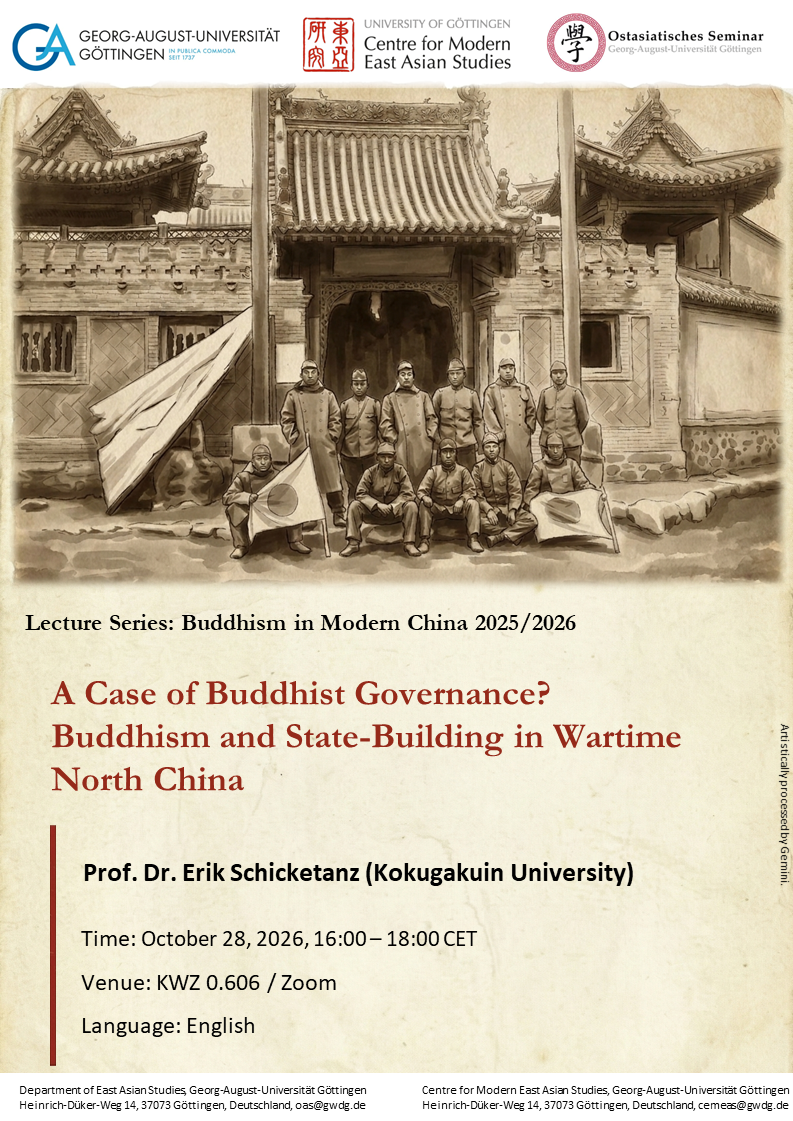
A Case of Buddhist Governance? Buddhism and State-Building in Wartime North China
Erik Schicketanz
Time: October 28, 2026, 16:00 – 18:00 CET
Venue: KWZ 0.606 / Zoom
Language: English
Zoom Link: https://uni-goettingen.zoom-x.de/j/69514667507?pwd=F2oPhOXY0ESirHaHk0k5dGy5vSvrv4.1
Abstract
This talk examines the role of Buddhism in the pro-Japanese regimes that emerged in North China after the outbreak of the Second Sino-Japanese War in July 1937. In the existing literature, the Provisional Government of the Republic of China (Linshi Zhonghua Minguo Zhengfu) and the North China Political Council (Huabei Zhengwu Weiyuanhui) have been largely ignored as mere Japanese “puppets” lacking any political subjectivity of their own. However, reducing the collaborators to simple tools of the Japanese military does not adequately capture these political entities. In fact, approaching the Chinese collaborators and the political structures they sought to build through the lens of religion and Buddhism in particular opens space for a more complex understanding of the nature of the occupation-state in North China and the motivations of those who chose to collaborate with the Japanese. The talk will analyze state policies towards Buddhism, the activities of Buddhist organizations such as the Buddhist Common Purpose Society (Fojiao tongyuanhui) and the Lotus Pond Life-Releasing Society (Lianchi fangsheng hui) under occupation, as well as the ideas and deeds of individual collaborators to show that Buddhism was a central force animating the collaborationist project and even a defining aspect of collaborationist governance.
Short Bio
Erik Schicketanz is Assistant Professor in the Faculty of Shinto Studies at Kokugakuin University in Tokyo. He earned his doctorate from the Department of Religious Studies at the University of Tokyo. His research focuses on the relationship between religion and politics within the context of modern Japanese and Chinese history. His first monograph Daraku to fukkō no kindai Chūgoku bukkyō (“Chinese Buddhism Between Decline and Revival,” Hōzōkan, 2016) focused on the notion of decline among modern Chinese Buddhists and how their historical consciousness was shaped by their interactions with Japanese Buddhists. He is currently working on a second monograph manuscript that examines the role of religion in the state-building project in North China under Japanese occupation during the Second Sino-Japanese War.