

- This event has passed.
Lecture Series: Buddhism in Modern China 2025/2026: Dragon Dwelling in a Buddhist Land: The Religious Journey of a Centenarian Monk
December 2025 @ 10:00 - 12:00
Event Navigation
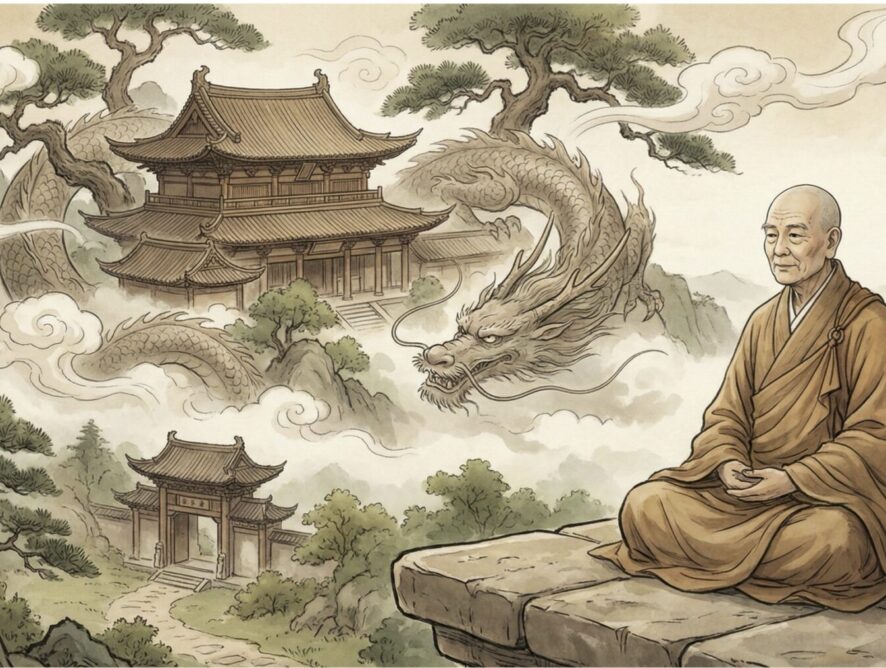
龙居佛地:一位百岁僧人的宗教历程/ Dragon Dwelling in a Buddhist Land: The Religious Journey of a Centenarian Monk
Time:18. December 2025 CET 10:00 am–12:00 pm Online Speech via Zoom
Register in advance for this meeting:
https://uni-goettingen.zoom-x.de/meeting/register/DUk42lG4QpalgCW06b2M9A
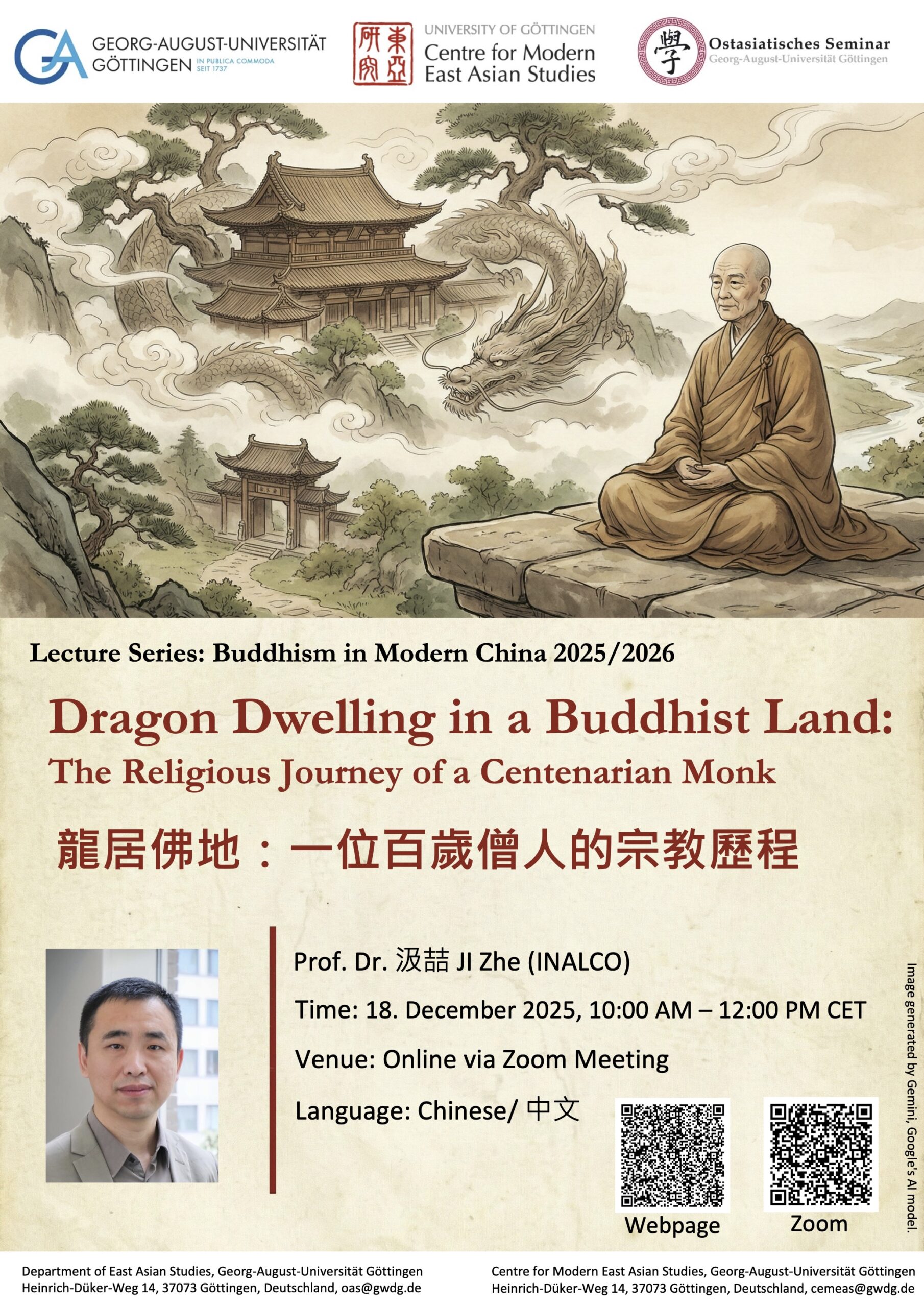
Lecture Speaker:Ji Zhe 汲喆 (INALCO
Profile:(Chinese Version) 汲喆,法国国立东方语言文明学院(Inalco)社会学教授、东语-圣严近现代汉传佛教讲席教授、法国多学科佛教研究中心(CEIB)主任。他的主要研究领域包括近佛教现代性、宗教全球化、宗教社会学理论与法国汉学史。著作包括《宗教、现代性与时间性:当代禅宗的社会学》 (Religion, modernité et temporalité: une sociologie du bouddhisme chan contemporain, CNRS Editions, 2016),主编有《二十世纪中国佛教的两次复兴》(与Daniela Campo、王启元合编,复旦大学出版社,2016)、《得道与成圣——现代中国宗教权威的建构》(Making Saints in Modern China , co-edited with David Ownby and Vincent Goossaert, Oxford University Press, 2017)、《改革开放时代的中国佛教》(Buddhism after Mao: Negotiations, Continuities, and Reinventions, co-edited with Gareth Fisher and André Laliberté, University of Hawai‘i Press, 2019)、《现代世界的思想者——齐美尔研究辑选》(与任强合编,商务印书馆,2021)、《新时代中国的佛教嬗变——国家、文化与宗教之间》(Metamorphosis of Buddhism in China’s New Era: Between State, Culture, and Religion, co-edited with David L.Wank and Ashiwa Yoshiko, Bloomsbury Academic, 2025)等。
(English Version) Ji Zhe is a Professor of Sociology and the holder of the Inalco-Sheng Yen Chair for the Studies of Modern and Contemporary Chinese Buddhism at the Institut National des Langues et Civilisations Orientales (Inalco), as well as the Director of the Centre d’Études Interdisciplinaires sur le Bouddhisme (CEIB). His primary research areas include Buddhist modernity, the globalization of religion, sociological theories of religion, and the history of French sinology. His publications include Religion, modernité et temporalité: une sociologie du bouddhisme chan contemporain (CNRS Editions, 2016); and he has served as editor or co-editor of 二十世纪中国佛教的两次复兴 (co-edited with Daniela Campo and Wang Qiyuan, Fudan University Press, 2016); Making Saints in Modern China (co-edited with David Ownby and Vincent Goossaert, Oxford University Press, 2017); Buddhism after Mao: Negotiations, Continuities, and Reinventions (co-edited with Gareth Fisher and André Laliberté, University of Hawai‘i Press, 2019); 现代世界的思想者——齐美尔研究辑选 (co-edited with Ren Qiang, The Commercial Press, 2021); and Metamorphosis of Buddhism in China’s New Era: Between State, Culture, and Religion (co-edited with David L. Wank and Ashiwa Yoshiko, Bloomsbury Academic, 2025), among others.
Abstract:(Chinese Version) 本研究依据文献与访谈,记述了江苏大林禅寺静海老和尚(1919-2019)一生的宗教经验。出身极贫、早入小庙为僧的静海,后因进入佛学院受教育而得以成为僧团精英的一员。1950年后他被迫还俗,1982年复出,并于1989年离开天宁寺,投身重建武进大林寺。在大林寺,他不仅重建了寺庙,聚集了信众,而且勉力创办了武进佛学院,使大林寺逐步成为当地的一个佛教中心。静海的历程折射了一百多年来中国政治与宗教的宏观变迁,同时也在展现了近代汉传佛教变革与重建的一些重要机制。一方面,二十世纪上半叶出现的佛学院,对于僧团内部的社会流动性产生了重大影响。正是得益于这一新制度,静海本人才摆脱了小庙应付僧的命运,经过“学僧”这一过渡性身份,最终转变为大丛林的法师。另一方面,静海所主持的大林寺重建过程反映了佛教传统对原有地方传统的吸收和运用的高超能力。例如,当地的道教遗产“白龙”和“龙母”崇拜,不仅得到了重新肯定,而且被转化为佛教功德和成就的证明。总地来看,静海老和尚的佛教生涯可以分为两个部分。他的前半生都是在不同佛教制度框架内寻找自己的位置;他的后半生——以他在1989年主动离开著名的天宁寺为转折点——则将自己前半生的经验融入到重建大林寺的策略之中。在这个意义上 ,静海个人的小故事与1980年代之后中国大陆佛教复兴的大故事分享了相同的母题,即对二十世纪上半叶的某种再现或折返。
Abstract: (English Version) Based on textual sources and interviews, this study recounts the religious experiences of Master Jinghai (1919–2019) of Dalin Chan Temple in Jiangsu. Born into extreme poverty and ordained at a small rural temple at an early age, Jinghai later entered a Buddhist academy, which enabled him to rise into the ranks of the monastic elite. After 1950, he was compelled to return to lay life; he reentered the sangha in 1982 and, in 1989, left Tianning Temple to devote himself to the reconstruction of Dalin Temple in Wujin. At Dalin Temple, he not only rebuilt the monastery and gathered a community of devotees, but also worked to establish the Wujin Buddhist Academy, gradually transforming Dalin into a local center of Buddhist activity.
Jinghai’s life journey mirrors the broader political and religious transformations that unfolded across China over the past century, while also revealing several key mechanisms behind the reform and reconstruction of modern Chinese Buddhism. On the one hand, the emergence of Buddhist academies in the first half of the twentieth century profoundly reshaped social mobility within the sangha. It was precisely through this new institutional pathway that Jinghai escaped the fate of remaining an obscure monk in a small rural temple and, through the transitional status of a “student-monk,” ultimately became a Dharma teacher in major monastic centers. On the other hand, the process of reconstruction that Jinghai oversaw at Dalin Temple illustrates the remarkable capacity of Buddhist tradition to absorb and repurpose local traditions. For instance, local Daoist heritages such as the cults of the “White Dragon” and “Dragon Mother” were not only reaffirmed but were transformed into proofs of Buddhist merit and accomplishment.
Overall, Master Jinghai’s Buddhist career may be divided into two phases. His early life was marked by efforts to find his place within various institutional frameworks of modern Buddhism; his later life—beginning with his voluntary departure from the renowned Tianning Temple in 1989—integrated his earlier experiences into a strategic blueprint for rebuilding Dalin Temple. In this sense, Jinghai’s personal narrative shares the same underlying motif as the revival of Buddhism in mainland China after the 1980s: a return to, or rearticulation of, certain institutional models and aspirations originating in the first half of the twentieth century.