
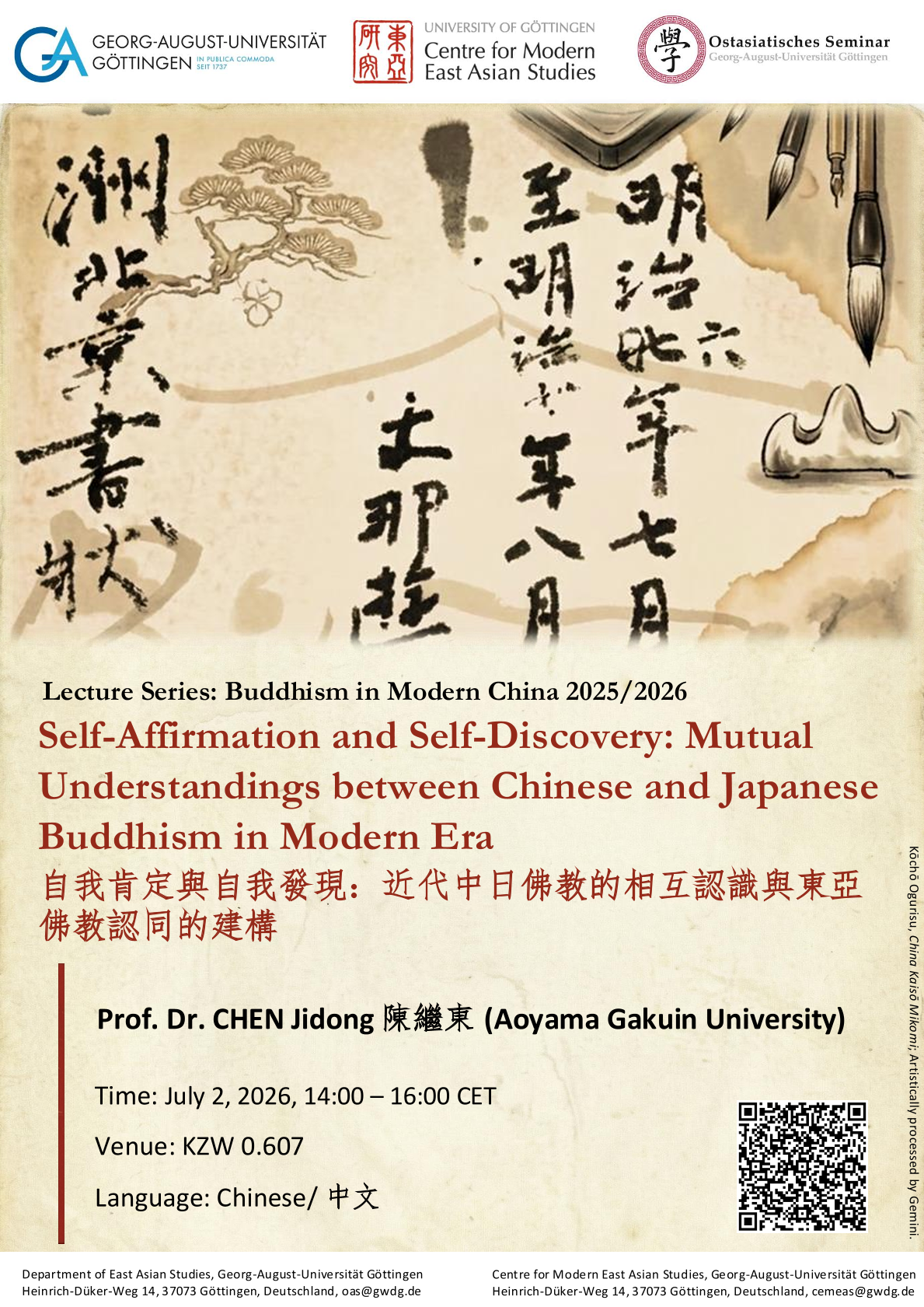
Self-Affirmation and Self-Discovery: Mutual Understandings between Chinese and Japanese Buddhism and the Construction of East Asian Buddhist Identities in Modern Era
自我肯定與自我發現:近代中日佛教的相互認識與東亞佛教認同的建構
02. July (16-18, KWZ 0.607)
The lecture will take place in a hybrid format and here is the zoom link (both lectures will use the same link): https://uni-goettingen.zoom-x.de/j/68015883500?pwd=sBRwN4M79JgwpsCTbrKKFpwsaNyiMh.1
Abstract
In the modern period, unprecedented contact and exchange unfolded between Chinese and Japanese Buddhism. From the mid-nineteenth century to the end of the Second World War, monks, scholars, and diplomats from both countries continuously observed, commented on, and studied each other’s Buddhist traditions, leaving behind a rich corpus of valuable records. From the Japanese monk Ogurisu Kōchō’s investigative journey to China, to Huang Zunxian’s Record of Japan (Riben Guozhi); from the intellectual exchanges between Yang Wenhui and Nanjō Bun’yū, to the mutual visits of Taixu, Daxing, and D. T. Suzuki, a history of Buddhist dialogue spanning nearly a century gradually took shape.
This lecture examines these figures and events in order to explore how modern Chinese and Japanese Buddhism redefined themselves through the process of “knowing the Other.” Japanese Buddhism, by reinterpreting the Chinese Buddhist tradition, gradually constructed its self-identity as the representative of East Asian Mahāyāna Buddhism. Chinese Buddhism, in turn, by observing the modernization of Japanese Buddhism, rediscovered its own historical traditions and cultural value, while also reflecting on paths of Buddhist reform and revival.
This history is not only one of Sino-Japanese Buddhist exchange, but also an intellectual history in which the self is discovered through the Other. The processes of “self-affirmation” and “self-discovery” thus constitute one of the most important historical questions in the formation of modern East Asian Buddhist identities.
近代以來,中日佛教之間展開了前所未有的接觸與交流。從十九世紀中葉到第二次世界大戰結束,兩國僧侶、學者與外交人士不斷觀察、評論和研究對方的佛教,留下了大量珍貴記錄。從日本僧人小栗栖香頂來華考察,到黃遵憲撰寫《日本國志》;從楊文會與南條文雄的思想交流,到太虛、大醒、鈴木大拙等人的相互訪問,形成了一段跨越近百年的佛教對話史。
本講座將透過這些人物與事件,探討近代中日佛教如何在「認識他者」的過程中重新理解自我。日本佛教藉由重新詮釋中國佛教傳統,逐漸建立其作為東亞大乘佛教代表的自我認同;中國佛教則透過觀察日本佛教的近代化發展,重新發現自身的歷史傳統與文化價值,並思考佛教改革與復興的道路。
這段歷史不僅是一部中日佛教交流史,更是一部透過他者發現自我的思想史。所謂「自我肯定」與「自我發現」,正是近代東亞佛教認同建構過程中最值得關注的歷史課題。
Chen Jidong holds a B.A. and M.A. in Philosophy from Peking University and a Ph.D. in Buddhist Studies (Literature) from the University of Tokyo. He has previously served as a lecturer in the Department of Philosophy at Peking University and as a specially appointed associate professor at Musashino University in Japan. He is currently a professor at Aoyama Gakuin University.
His research focuses on the history of Chinese Buddhism, modern Sino-Japanese Buddhist exchanges, and modern Chinese intellectual history. His major monographs include Buddhist Studies in the Late Qing Dynasty: Centered on Yang Wenhui and Ogurisu Kōchō’s Experience in Late Qing China: The Beginning of Modern Sino-Japanese Buddhist Exchange. His articles include “Is the Philosophy of Foreign Concepts Inherently Chinese? The Dilemma of Modern Chinese Intellectuals”, “The Intellectual Transformation of Lin Zhao”, and so on.
陳繼東,北京大學哲學系學士和碩士,東京大學佛教學博士(文學)。曾任北京大學哲學系講師、日本武藏野大學特任副教授,現為青山學院大學教授。專攻中國佛教史、近代中日佛教交流史、近現代中國思想史。著作有《清末佛教研究:以楊文會為中心》、《小栗栖香頂清末中國體驗:近代中日佛教交流的開端》,論文有《外來概念的哲學是否中國固有:近代中國知識人的困惑》、《林昭的思想變遷》等。